

Adult toy packaging is a three-layer system, transit carton, inner retail box and branded outer box, each carrying a different job: protection, regulatory information and brand presentation. Get any one of those three jobs wrong and you’ve either got a product that arrives damaged, a listing that fails compliance review, or a brand presence that doesn’t survive the unboxing. This guide walks you through each layer, the material and finish choices that actually matter, the labelling and privacy-shipping rules you need to meet, and how all of it moves your unit cost.
The Three Packaging Layers: Carton, Inner Box and Branded Outer Box
Your adult toy packaging specification starts with the shipping order, not the artwork, since each layer does a different job and the consumer only ever sees one of them.
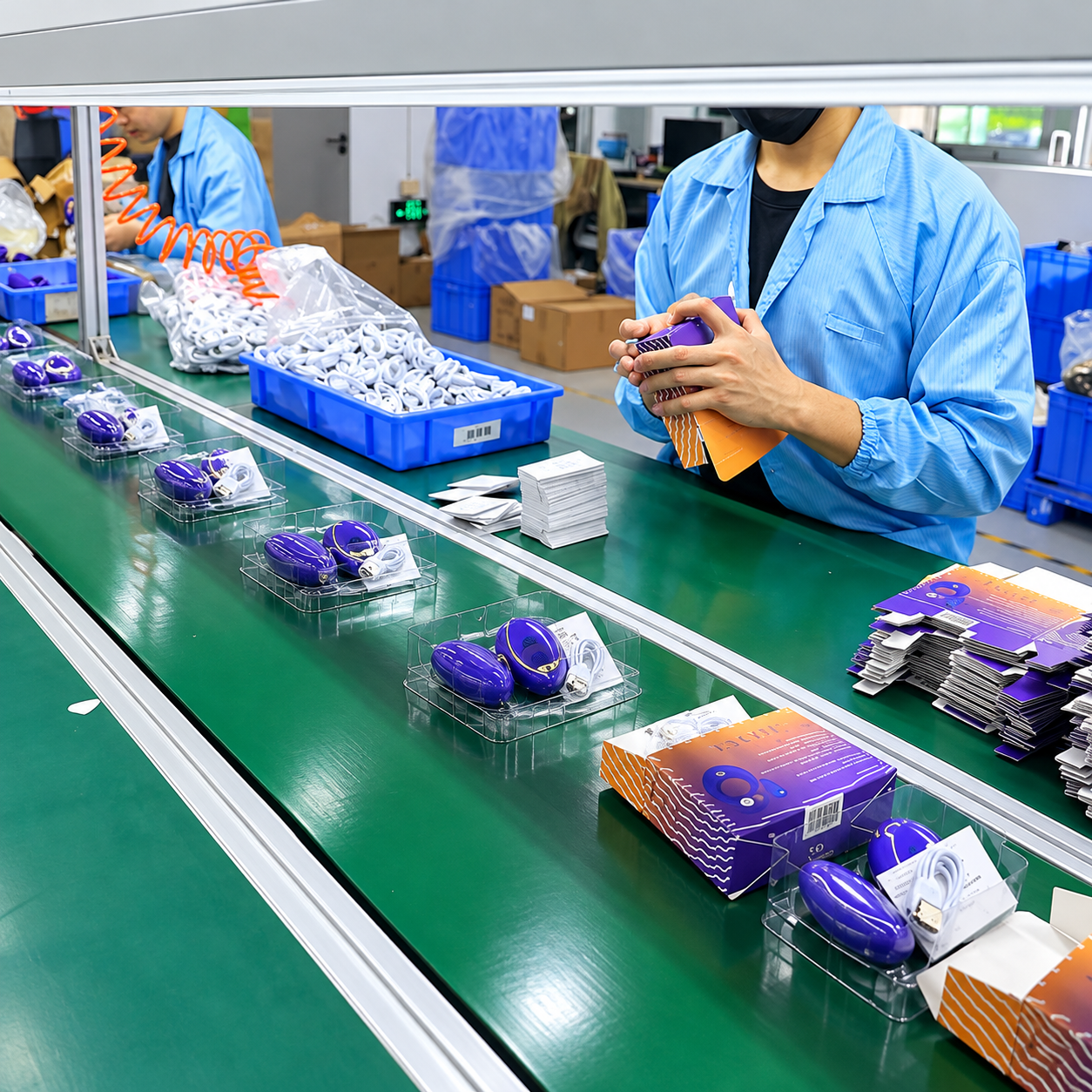
The transit carton goes first and does one job only, it protects the shipment through freight and warehouse handling, and you’ll never see it again once the product reaches a shelf. The inner or retail box sits underneath the branding and carries the regulatory load, barcodes, origin marks, warnings, the information a retailer’s compliance team actually checks. The branded outer box is the layer your customer actually sees, whether that’s a retail shelf or an unboxing moment, and it’s where your brand presentation decision lives. Your structural choice at each layer matters more than it looks: corrugated flute grade determines how well the transit carton survives rough handling, and whether you specify a folding carton or a rigid box at retail level changes both the unboxing feel and your unit cost meaningfully.
Packaging layers, purpose and specification choices. Confirm flute grade and board weight against your own shipping lane and courier before finalising a structure.
| Layer | Propósito | Seen by consumer | Typical material | Specification decision |
|---|---|---|---|---|
| Transit carton | Protects the shipment in transit and warehouse handling | No, removed before retail display | Corrugated board, flute grade matched to weight | Flute grade and board strength for the shipping lane |
| Inner or retail box | Carries regulatory and compliance information | Sometimes, depending on retail format | Folding carton or lightweight rigid board | Which mandatory marks fit without crowding the artwork |
| Branded outer box | Carries brand presentation and the unboxing experience | Yes, this is the shelf or unboxing face | Rigid box, greyboard wrap, or premium folding carton | Finish choice balanced against durability and budget |
| Insert or tray | Holds the product in place and absorbs shock | Yes, visible when the box is opened | Moulded EVA, moulded pulp, or die-cut card | Insert material matched to drop-test and courier handling |
If branded presentation at the outer layer matters to your launch, private label packaging is where that decision actually gets specified, logo placement, finish and box structure together rather than as an afterthought bolted onto an existing design.

Material and Finishing Options
Your substrate choice at each layer decides both the look and the failure mode, so it’s worth treating as a specification decision rather than a visual preference.
Paperboard comes in GSM bands, heavier stock costs more but resists crushing better in transit, while rigid greyboard wrapped in printed paper gives you a premium retail feel at a real cost and weight penalty. Moulded pulp and plastic alternatives sit at the budget end, functional but with a visibly different hand-feel than board. Finishes carry their own trade-offs you should weigh against how the product actually travels, not just how it photographs in a studio. Matte or soft-touch lamination feels premium on day one but shows fingerprints and scuff marks after repeated handling. Spot UV adds a glossy accent that can scratch if it’s not protected in transit. Foil stamping looks sharp on a logo but can chip or lift at box edges and corners. Embossing adds texture that can flatten if the boxes get compressed in a shipping stack. Your insert matters just as much as the outer finish, since a moulded EVA, moulded pulp, or die-cut card tray is what actually determines whether the product survives courier handling rather than just looking good in a product photo of the finished piece, research which insert and structure combination actually survives real courier handling before you commit to tooling based on a sample that only had to survive a photo shoot.
un manufacturing partner that also sources packaging in-house tends to catch the mismatch between a finish that photographs well and one that actually ships well, before it becomes your returns problem.
| Finish option | Visual effect | Relative cost band | Durability risk | Best-fit product tier |
|---|---|---|---|---|
| Matte or soft-touch lamination | Soft, premium hand-feel | Mid | Shows fingerprints and scuffs under repeated handling | Mid-tier to premium retail |
| Spot UV | High-gloss accent against a matte base | Mid to high | Can scratch or dull if not protected in transit | Premium retail and limited runs |
| Foil stamping | Metallic accent on logos or text | Alto | Can chip or lift at box edges and corners | Premium and gift-tier packaging |
| Embossing | Raised or recessed texture on the surface | Mid to high | Can flatten under compression in shipping stacks | Premium retail where tactile branding matters |
Compliance Labelling: Barcodes, Warnings, Origin and Recycling Marks
Custom packaging adult toys projects live or die on a short list of mandatory artefacts, and getting any one of them wrong is a listing problem, not a cosmetic one.
An EAN or UPC barcode needs to sit in a specific placement zone to scan reliably, GS1’s own placement guidance recommends the lower right section of the back panel for checkout scanning, kept away from the package edge with enough surrounding white space, and printed at full size rather than scaled up or down from existing art. Country of origin marking is a separate requirement entirely, and US customs rules require either the product or its container to carry a conspicuous, legible, durable origin mark, missing or incorrect marking can hold a shipment at the border or trigger penalties on repeated violations. Importer details, recycling marks and disposal marks round out the mandatory list, and you should confirm which of these are actually mandatory versus voluntary in your specific destination market rather than assuming your home market’s rules travel with the shipment. Warning text and age-suitability conventions add a further layer, and a single global artwork file usually fails at least one target market’s language or format requirement, so plan for a per-market artwork review rather than one universal design.

Privacy-Shipping Standards
Discreet packaging sex toys buyers expect follows a specific, learnable standard rather than a vague promise, and it’s worth holding your supplier to the specifics rather than the general idea.
The standard itself is simple to state: an unbranded outer carton, no product descriptor anywhere on the label, no invoice included inside the parcel, and a neutral sender name on the shipping label. What actually breaks this promise at scale isn’t the pack design, it’s fulfilment consistency, a warehouse team that gets this right on a sample run but slips on the two-hundredth order is a bigger risk to you than any packaging choice. Returns handling deserves the same scrutiny you’d give outbound shipping, since a returned product moving back through a courier network under a mismatched label undoes the entire privacy standard you specified on the way out.
Sustainable Packaging Trends
Sustainable packaging choices genuinely reduce material use, but they come with trade-offs worth weighing honestly rather than adopting on principle alone.
Recycled and FSC-certified board, soy or water-based inks, removing single-use plastic windows, and paper-based inserts in place of moulded plastic are the common moves buyers make here. The trade-off cuts both ways: a lighter pack lowers material use, but it can also raise damage rates and returns if the structure wasn’t tested for the lighter spec, so any footprint claim needs real support behind it, not just a lighter box on a scale. That support matters more than ever given where regulation is heading. The UK’s own guidance on environmental claims sets out six principles, truthful, clear, not omitting material information, fairly compared, assessed across the full life cycle, and properly substantiated, and the EU is moving in the same direction on unsubstantiated green claims. Treat any recyclability, compostability or carbon claim as something you need a documented provenance file behind, not a marketing line you add because it sounds right.

How Packaging Moves Unit Cost
Packaging cost breaks into six parts, and knowing which ones are fixed and which ones scale with volume changes how you actually negotiate a quote.
Structure and tooling are largely fixed costs, you pay for the die line and the mould regardless of whether you order a thousand units or a hundred thousand. Material, finishing and print setup scale differently, material cost moves with board weight and volume, finishing adds a per-unit cost that shrinks as volume grows, and print setup is a one-time charge spread thinner the larger your run. MOQ break points on cartons, inserts and tooling each sit at different volumes, so a quote that looks expensive at your current order size may look very different once you cross the next break point. Bundling packaging into a launch kit alongside the product itself changes the economics again, since a supplier quoting both together usually has more room to flex on packaging margin than one quoting packaging alone. Treat every cost driver here as a range conditional on your specification, never a quoted fixed price, and keep in mind that packaging is ultimately a share of your landed cost, not a cost center to minimise in isolation from everything else that share affects.
Planning a Packaging Change This Season?
Send us your product dimensions, target market and finish direction. We will return a packaging proposal with a physical sample.
Request a Packaging Proposal and Physical Sample – See Our OEM and ODM Manufacturing Capabilities
Structural design and physical sampling in house – market-specific labelling review – packaging and product quoted together
FAQ
What does discreet packaging mean for adult toys?
A plain outer carton, no brand or product descriptor on the label, no invoice inside, and a neutral sender name. The standard covers the whole journey, returns included, so confirm your supplier holds it consistently rather than only on a sample order.
How much does custom adult toy packaging cost?
Your cost splits into structure, material, finishing, print setup, tooling and volume band. Structure and tooling are largely fixed while material and finishing scale. Ask for a range against a stated quantity rather than a single number with no volume attached.
Can I put my own design on the box?
Yes, subject to your print method and MOQ. Flexo suits simpler artwork at volume. Offset and digital support finer detail at lower volumes, and each print method changes your setup charge, so confirm which one fits your run size before finalising artwork.
What labelling is legally required on the box?
Barcodes, country of origin and importer details are the common core across most markets. Warning text, recycling marks and language requirements vary by destination, so your artwork should be reviewed per market rather than approved once and reused everywhere.
Is sustainable packaging more expensive?
Often slightly, and not always. Removing plastic windows and laminated finishes can offset higher board costs. The net cost depends on your volume and structure, so treat it as a specification exercise rather than assuming either direction by default.
How long does packaging development take?
Your development timeline covers structural design, a physical sample, artwork and a print proof. Your timeline depends on how many sample rounds you need, so agree the approval sequence with your supplier before tooling starts, not after.