

Adult toy safety is four documents and four habits: a battery test report, an ingress rating for the exact model, a material declaration, and a care card that tells your customer how to charge, wash and store the product. If you import, the documents are the part you get asked about.
Electrical Safety: Battery Types and Charging Rules
Most faults you will handle start at the charger, so the power source is the first line of your specification.
Three power sources cover the category, and you specify each differently.
Lithium-ion. The sealed rechargeable cell in most wands, bullets and app-controlled units. High energy density, low self-discharge, and not replaceable by your customer.
Lithium-polymer. The same chemistry in a pouch format, which is why you meet it in slim or curved shells where a cylindrical cell will not fit.
Replaceable alkaline. Usually AAA or AA, and the only type your customer can change. They leak if they sit unused for months, which is why the care card tells buyers to remove cells before storage.
For sex toy battery safety the standard buyers name is IEC 62133-2, the lithium-systems part of IEC 62133 from the International Electrotechnical Commission. For transport you need a second one: PHMSA states that cells and batteries offered for transportation must have passed the design tests in Section 38.3 of the UN Manual of Tests and Criteria, and that since 21 January 2022 manufacturers must make test summary documents available upon request.
Voltage and capacity are per model, so ask for the chemistry, cell voltage, rated capacity and charge current before you quote. A report on one cell does not cover a different cell in the same housing.
Table: battery types and the charging rule for each.
| Tipo de batería | Typical Device | Charging Rule |
|---|---|---|
| Lithium-ion | Wands, rechargeable bullets, app units | Supplied cable, charge to full, then unplug |
| Lithium-polymer | Slim or curved shells, wearables | As above, and never charge wet contacts |
| Replaceable alkaline | Entry-price bullets, remote handsets | No charging, and remove cells before storage |
Rows are power sources, and the rule in each row is a starting instruction rather than a warranty. The model’s own instruction card overrides the table.
Charging Rules That Prevent Premature Failure
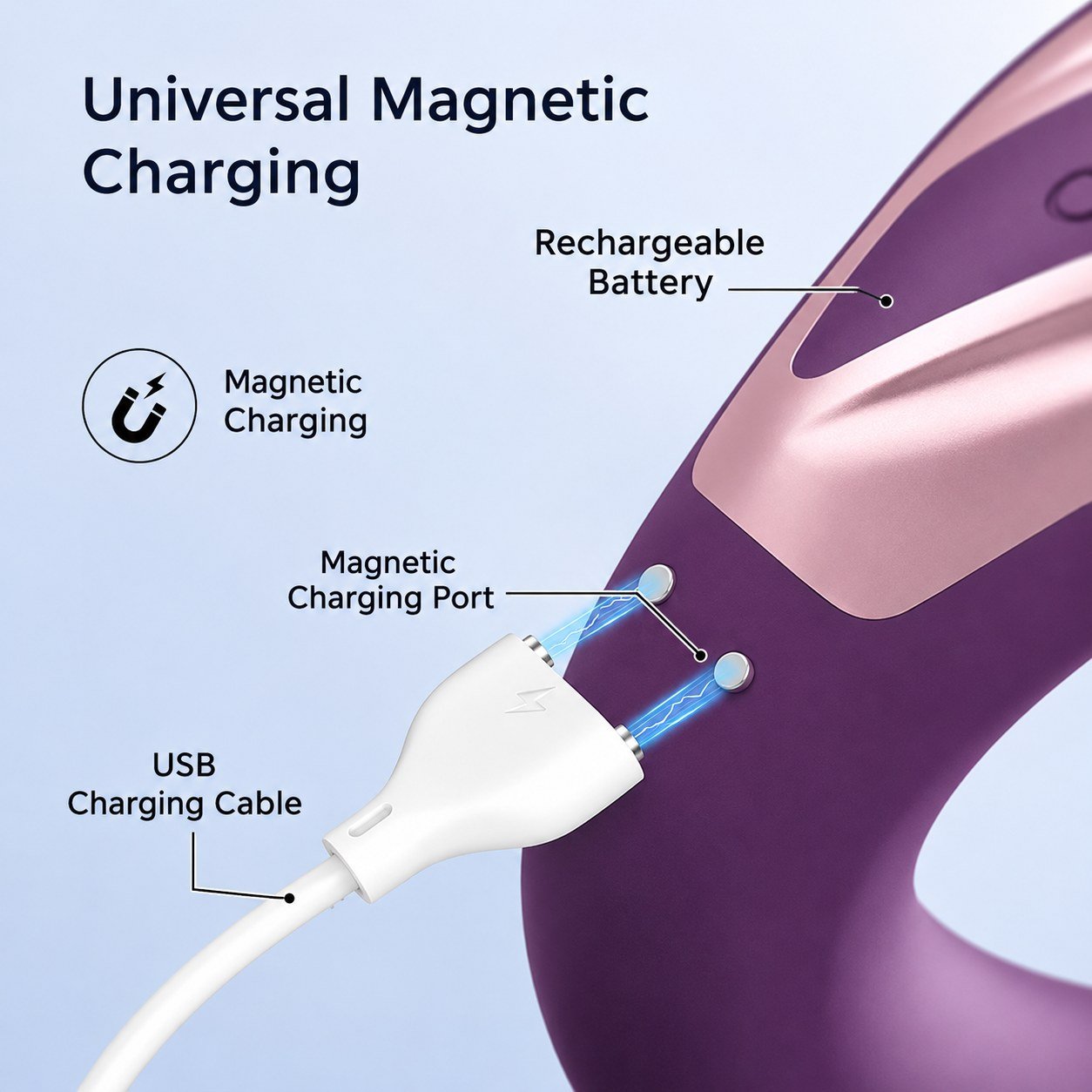
Use the cable the maker supplies, because the maker sets the voltage you are charging at. New York State’s lithium-ion battery safety guidance gives you the rest: plug directly into a wall outlet, never leave a device charging unattended or while asleep, and unplug it once it is full.
Dry the contacts first, because you never put current through a wet contact. For storage, Apple’s battery guidance is the figure to print: keep the device at around 50 per cent charge for long-term storage, powered down, in a cool, moisture-free place below 32 °C (90 °F), and top it back to 50 per cent every six months. WINYI’s guide on how to store sex toys makes the same point about wiping charging contacts fully dry before you close anything up.
The rule: supplied cable, wall outlet, dry contacts, unplug when full.

Cómo leer los grados de resistencia al agua IPX
An IPX7 rating means the device survives immersion in one meter of water for 30 minutes when tested new. It is not a claim for continuous use, greater depth or an aging seal.
The scale you are quoting lives in IEC 60529, Degrees of protection provided by enclosures (IP Code), Edition 2.2, published 29 August 2013. The second numeral is the water digit, and each value names a test rather than a promise, as the table below sets out.
A rating describes a new seal, so treat it as a starting condition. If your listing says waterproof sex toy ipx7, you need a report naming that model, because a rating on one shell does not carry across a range. WINYI’s lab page describes its IPX7 test tank as immersing products at a depth of 1 meter for 30 minutes and then checking for water ingress – that is the factory’s result on the models it runs, not proof about the product you buy.
Table: IPX waterproof ratings and permitted use.
| Rating | Test Condition | Permitted Use |
|---|---|---|
| IPX0 | No water test is applied | Keep dry, wipe the body only |
| IPX4 | Splashing from an oscillating tube or nozzle | Splashes only, never under a tap |
| IPX6 | Water jets from a 12.5 mm nozzle | Jets tolerated, immersion not permitted |
| IPX7 | Temporary immersion, 0.15 m to 1 m, tested new | Brief immersion if the instructions allow |
| IPX8 | Continuous immersion on the maker’s agreed terms | Only within those stated terms |
Rows are test conditions, not service lives. A rating belongs to the tested model and its seal at the time of the test, and the care card cannot extend it.
Seals, Ports and Real-World Water Resistance
The rating belongs to the seal, and you can inspect a seal. Magnetic contacts sit proud, a gasket takes a set, and a threaded cap works only when closed.
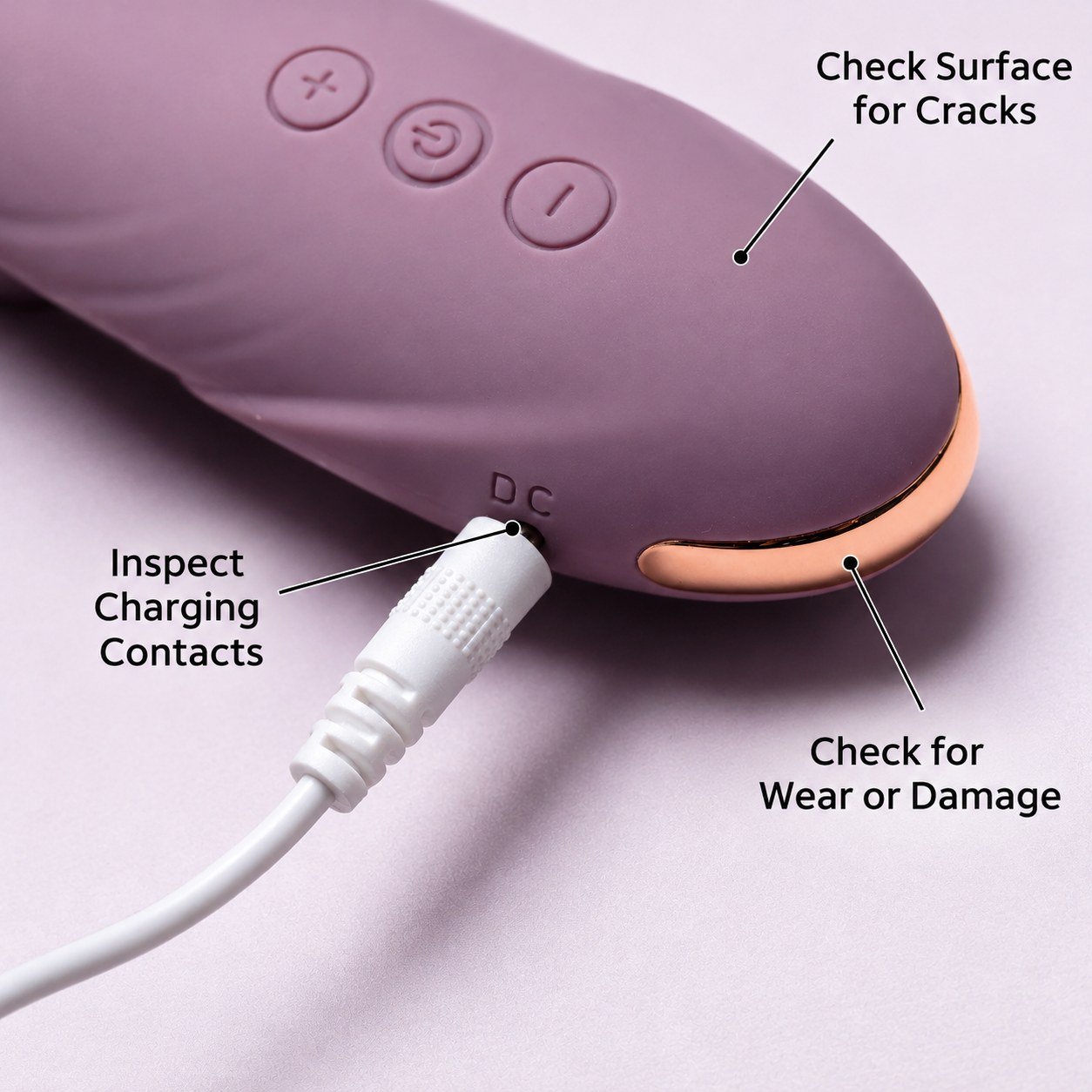
So give your customer three checks before use: look at the gasket, dry the contacts, close the cover. Tell them what voids a rating too: a drop onto a hard floor, a cracked shell, a loose cap. None of that shows in a photograph, and the cleaning method is in WINYI’s guide on how to clean adult toys.
The rule: inspect the seal, not the spec sheet.
Handling Charging Faults and Overheating
Mild warmth in a motor housing after a long session is ordinary. Hot to the touch is not, and adult toy safety depends on your customer knowing the difference.
Your warning signs come from the fire service rather than a brand. New York State’s guidance lists a device that is extremely hot, swelling or bulging, any lump or leakage, a hissing, cracking or popping sound, an odor, and smoke. Any one of them retires the unit, and you never charge a swollen cell again.
Your stop rule is four steps in order: unplug it, move it away from soft furnishings, leave it to cool somewhere ventilated, and do not charge it again. Never puncture or crush a cell you have seen overheat, because damaging it makes the hazard worse.
Isolate the piece, record the batch code, and raise it as a batch question, because one failure in your shipment is a sample. WINYI’s página de servicios documents a five-stage QC process with three fixed photo-update checkpoints at material arrival, first-article approval and pre-shipment inspection, while the lab page lists waterproof verification, electrical and charging checks, acoustic testing and aging evaluation among its test items – so you can match a complaint to a stage.
The rule: warmth is normal, heat is not.
Body Hygiene and Sharing Between Partners
Hygiene is a material question, and the rating sets the limit.
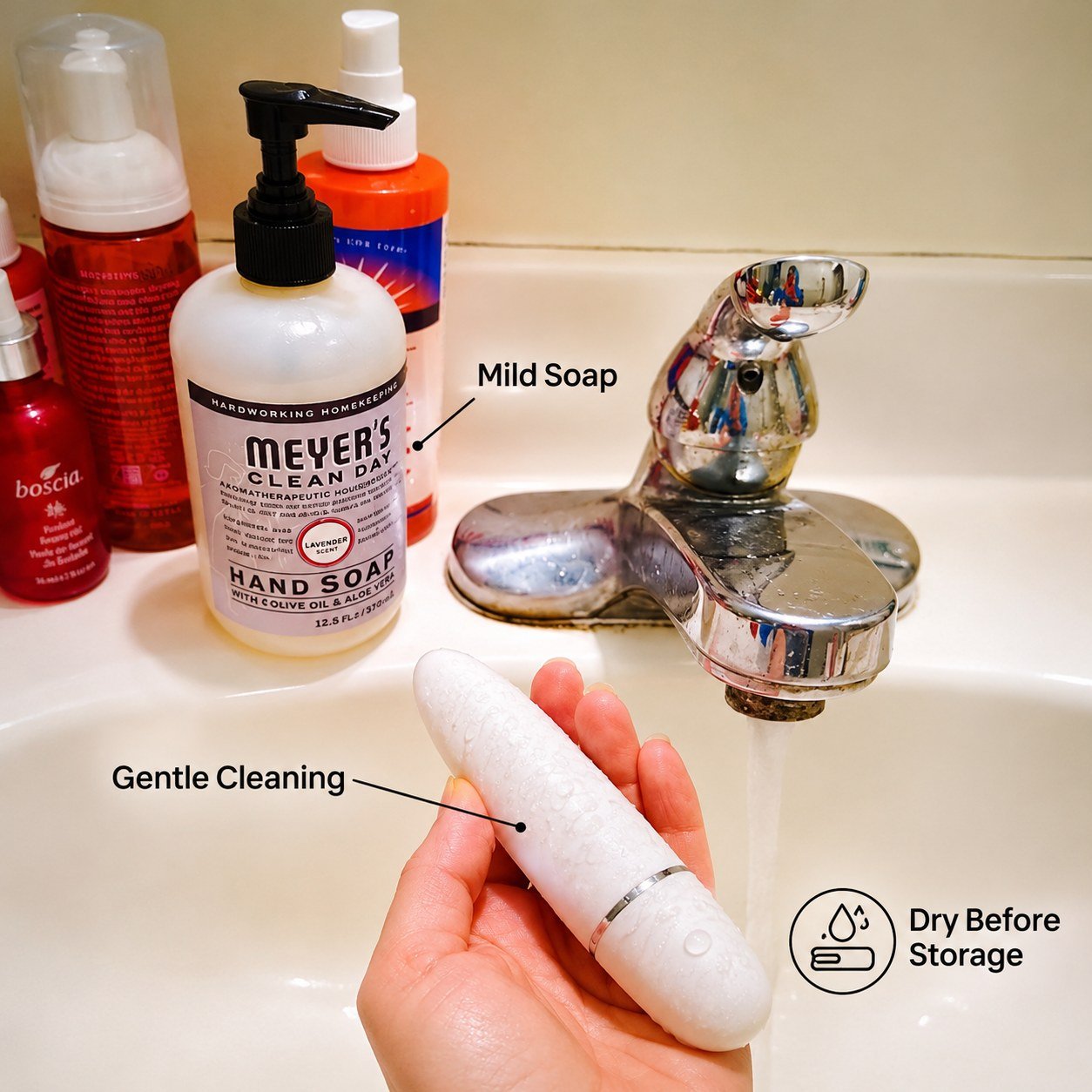
Planned Parenthood names both groups for you. Its non-porous list is 100 percent silicone (not silicone blends), hard plastic, stainless steel, aluminum and break-resistant glass; its porous list is silicone blends, jelly rubber, PVC, vinyl, TPR, TPE, elastomer and other rubbery plastics. The routine you print is mild soap and water after use, and before the product touches another person.
For adult hygiene products that means two sequences. On a non-porous surface a wash removes residue, and on a porous surface it reduces it, which is why you treat a porous product as single-user and keep the word sterile out of your copy. Never put a unit deeper into water than you can show its rating allows.
Are sex toys safe to share? Only with a barrier, or not at all. Planned Parenthood says a condom on a shared toy helps keep it clean, with a new condom any time a new person uses it; its sex toy guidance adds that you change the condom before the toy touches another person’s genitals. WebMD’s guidance gives the order-of-use rule: wash after each use and between using it on different parts of the body, and never move a toy from anus to vagina without washing it or changing the condom first.
Storage finishes it, and the method you need is in WINYI’s guide on how to store sex toys.
The rule: barrier, or do not share.
When to Replace a Product
Give your customer a wear checklist rather than a date.
Five signals end a product for you: a crack or split, a tacky surface, a lifted coating, a seal that will not close, and a charge that will not hold.
Do not print a service life in months unless the maker’s test data supports it, so ask for cycle and aging data per model and set your replacement line on condition. An electrical fault outranks age, so you retire a unit that overheats or swells whatever its date.
Battery Aging and Responsible Disposal
A lithium cell loses capacity across cycles, and your customer meets that as a shorter session. Ask for the cycle count behind any battery-life claim, and keep the claim off your pack without a report.
Disposal is regulated, so put it on your card. The US Environmental Protection Agency says lithium-ion batteries should not go in household garbage or recycling bins, that they belong at separate recycling or household hazardous waste collection points, that you tape the terminals with non-conductive tape or bag the battery separately, and that a damaged battery is a question for the manufacturer. PHMSA adds that damaged, defective or recalled cells carry more risk in transport than sound ones.
The rule: replace on condition.
What to Do in an Emergency
Overheating, smoke or an odor: unplug it, do not touch a swollen cell, ventilate the room. A burn or skin reaction: stop, cool the skin with water, seek qualified help. Anything retained that will not come out: seek medical attention straight away. Nothing here is medical advice, and a clinician decides what happens next.
Reporting, Recall and Traceability
Report a fault with the batch code, the purchase date and photographs, to the seller first and to your market’s safety authority where it is a hazard rather than a defect. Check recall notices before you buy a batch and before you resell one.
That is why traceability belongs in your specification. Ask for a batch code on the unit or the carton, and ask what you can trace with it at the factory. WINYI’s página de certificaciones states that a report normally applies to the tested model, material, component or product family described in its scope, and asks buyers to confirm the model number, report scope, issue date and destination-market requirements. Read that line before you accept any document as covering your order.
The rule: log the batch code.
Sourcing Toys That Pass a Safety Review
WINYI is an adult-toy OEM and ODM manufacturer in Shenzhen, producing silicone, TPE and ABS products with sealed motor housings, and supporting private-label branding and the documentation a safety review asks for.
Send your target market and product type and you get back a model match, the ingress rating and report scope for that model, the material declarations and a sample plan. The página de certificaciones lists what you can get today: a BSCI audit and ISO 9001 at factory level, BPA, RoHS, LCS and REACH/SVHC material reports, CE documentation, a UL 4200A report for applicable remote-control battery compartments, and land transport test reports with UN 38.3 where applicable. Cell-level standards such as IEC 62133-2 are worth requesting per model, and you name the issuing body, test scope, standard version and validity.
Ask for the paperwork in two parts, because a factory certificate and a product report answer different questions for you. Treat MOQ, sample terms and lead time as conditional until they are confirmed for your project. Adult toy safety is a document trail before it is a feature list, and the trail is what you are buying.
Request the safety and compliance pack for the models you are quoting, including the battery test summary, the ingress report for the exact model and the material declarations. Tell us the target market and product type, since those two decide which documents apply.
Request a Safety and Compliance Pack – Vea nuestras capacidades de fabricación OEM y ODM
Per-model ingress and battery reports – material declarations and care-card copy – batch traceability and sample plan
FAQ
¿Es seguro usar juguetes eróticos?
Yes, when the certification, charging, ingress and hygiene rules are met. You want a battery test report, a material declaration, and a cleaning method that matches the material. Treat a missing document as a missing answer.
Is it safe to use a product in the shower or bath?
Only at IPX7 or above, on an undamaged seal, and within what the instructions permit. The port and the gasket are the weak points rather than the shell. Dry the contacts fully before you charge it.
Can you leave a product charging overnight?
Prefer not to. New York State guidance says never to leave a lithium-ion device charging unattended or while asleep, and to unplug it once it is full. Use the supplied cable in a wall outlet.
How do you clean a product shared with a partner?
Mild soap and water, and a new condom per partner, changed before the product touches anyone else. Cleaning reduces residue rather than sterilising anything, so keep a porous product to one user.
When should a product be thrown away?
At the first fault signal, or when the surface fails. A crack, a tacky surface, a lifted coating, a failed seal or a charge that will not hold all end it. Retire a swollen unit at once.
What should you do if a product gets hot while charging?
Unplug it, move it away from soft furnishings, let it cool somewhere ventilated, and do not charge it again. Swelling, a hissing or popping sound, an odor or smoke means you are finished with that unit.
Do products need certification before import?
Expect battery, electrical, material and labeling documents to be checked, and the list to differ by market. Ask per model for the document, the issuing body, the test scope, the standard version and the validity.