

Before you clean anything, read the instruction card that came with the model, because the maker sets what its surface, seals and charging contacts can take. Then you clean by material: soap and warm water for most surfaces, a gentler and slower routine for soft ones, and a wipe rather than a soak for anything with a motor.
Cleaning an adult toy means removing lubricant, residue and dust from its surface using a method chosen by material, not by brand. That is the rule your care instructions should carry, because it is the only one that survives a change of supplier.
The brand on the box tells your customer little about what the surface can take, while the material and the presence of a motor tell you nearly everything. The frequency table near the end gives you the answer at a glance.
Why Cleaning Is Not Optional
Three things land on a surface in normal use: lubricant residue, dust from storage and skin oils. Together they change how a product feels and how long your customer keeps it.
What they do next depends on the surface you are dealing with. On a non-porous material, residue sits on top, so a wash removes it. On a porous material, the surface absorbs some of it, so a wash reduces what is there rather than clearing it. That difference is why one routine cannot cover your whole shelf.
Keep the framing clean in the copy you publish. You are describing surface care, not making a health claim, and nothing on the care card should say that cleaning prevents infection or disease. Planned Parenthood’s sex toy guidance sets the practical baseline you can print: wash with mild soap and water after use and before a product touches another person, and follow the care directions that came with it.
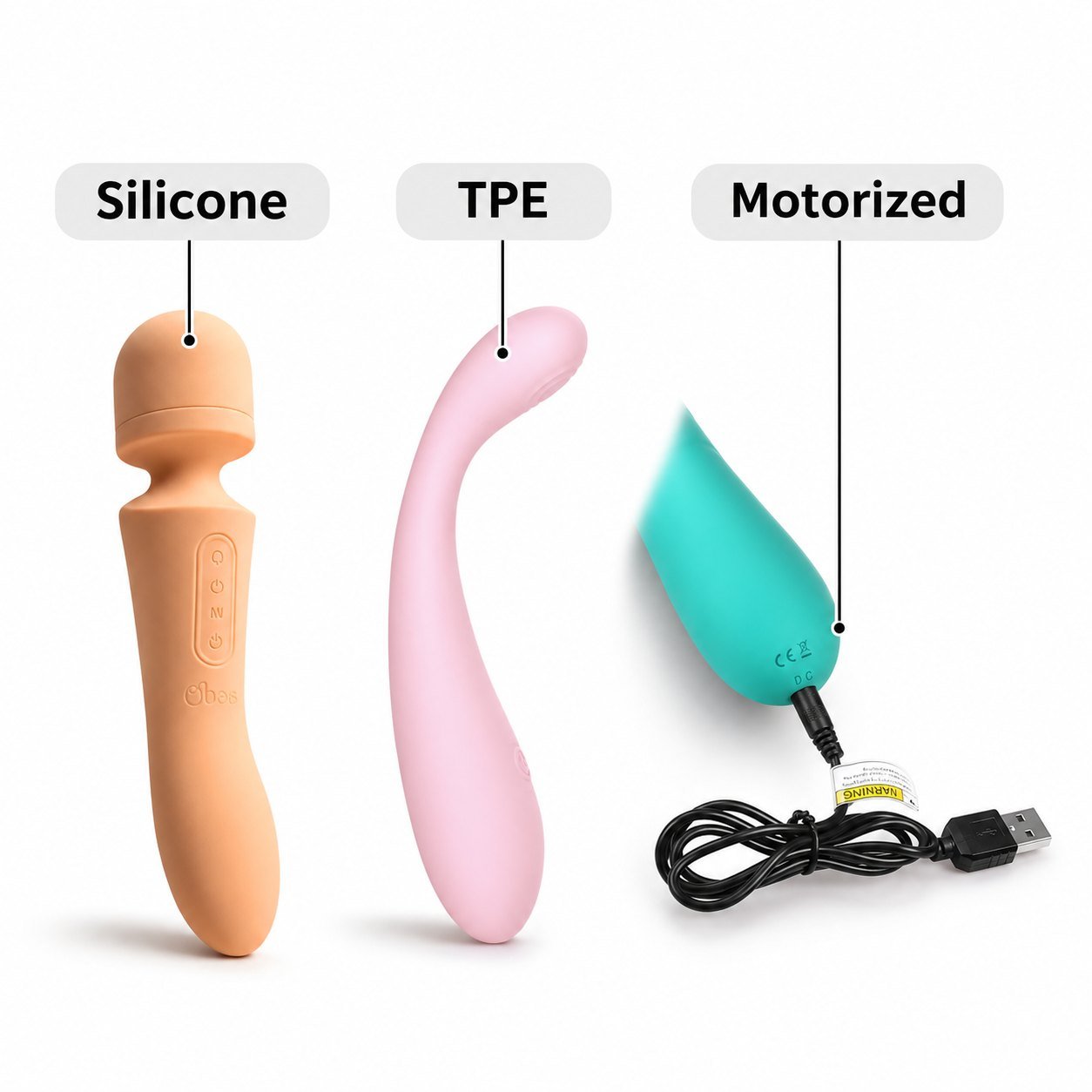
Method by Material: Silicone, TPE, ABS and Metal
Every material gets its own sequence, and the order of the steps matters more than the products you buy.
Non-Porous: Silicone, ABS, Stainless Steel and Glass
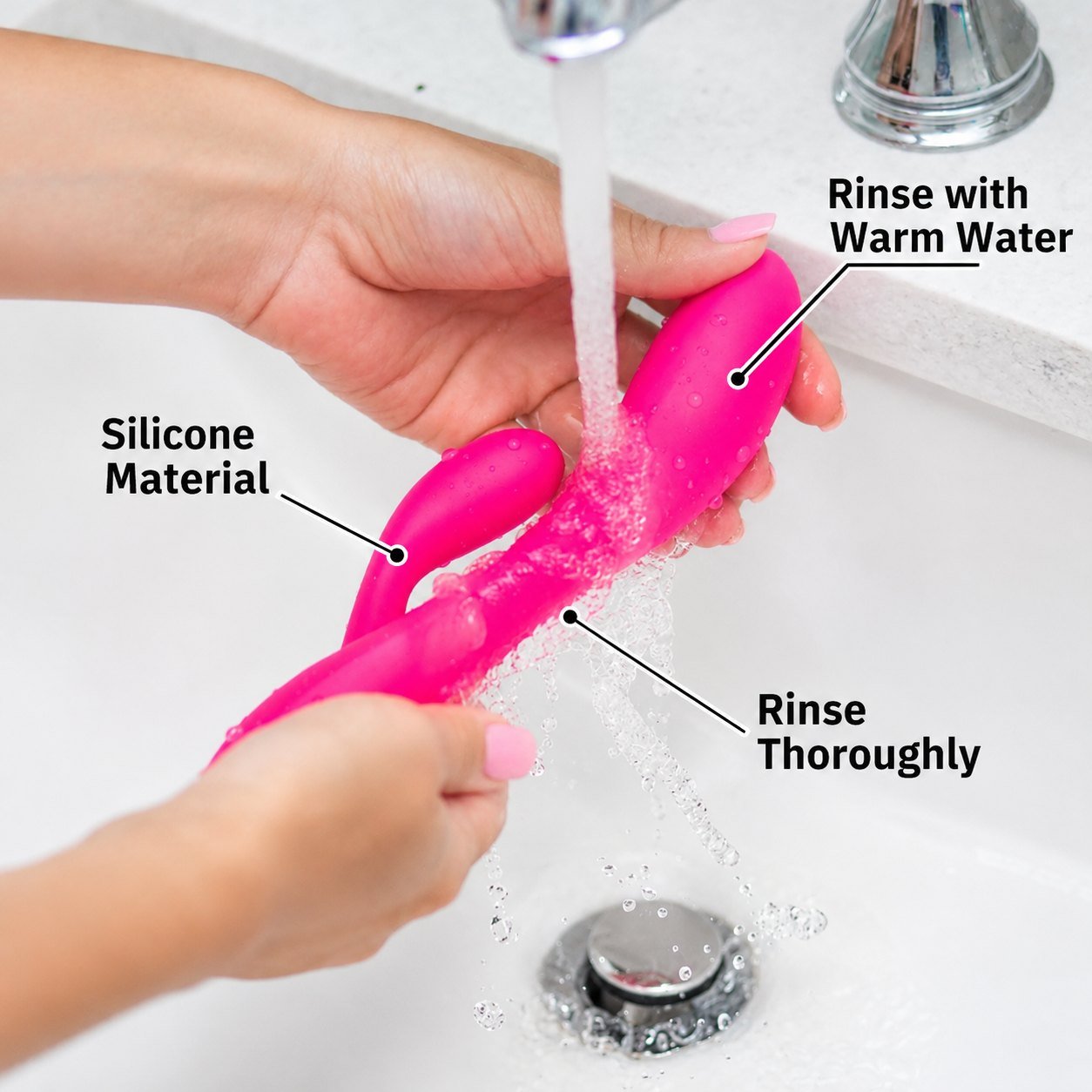
This group covers most of what you sell, and it is the only group where a mainstream medical source supports more than washing. WebMD’s dildo guidance, medically reviewed by Brunilda Nazario, MD, tells readers to choose a product made from non-porous materials – body-safe silicone, glass or metal – and notes that almost all sex toys can be cleaned by hand with soap and warm water.
Your sequence is four steps:
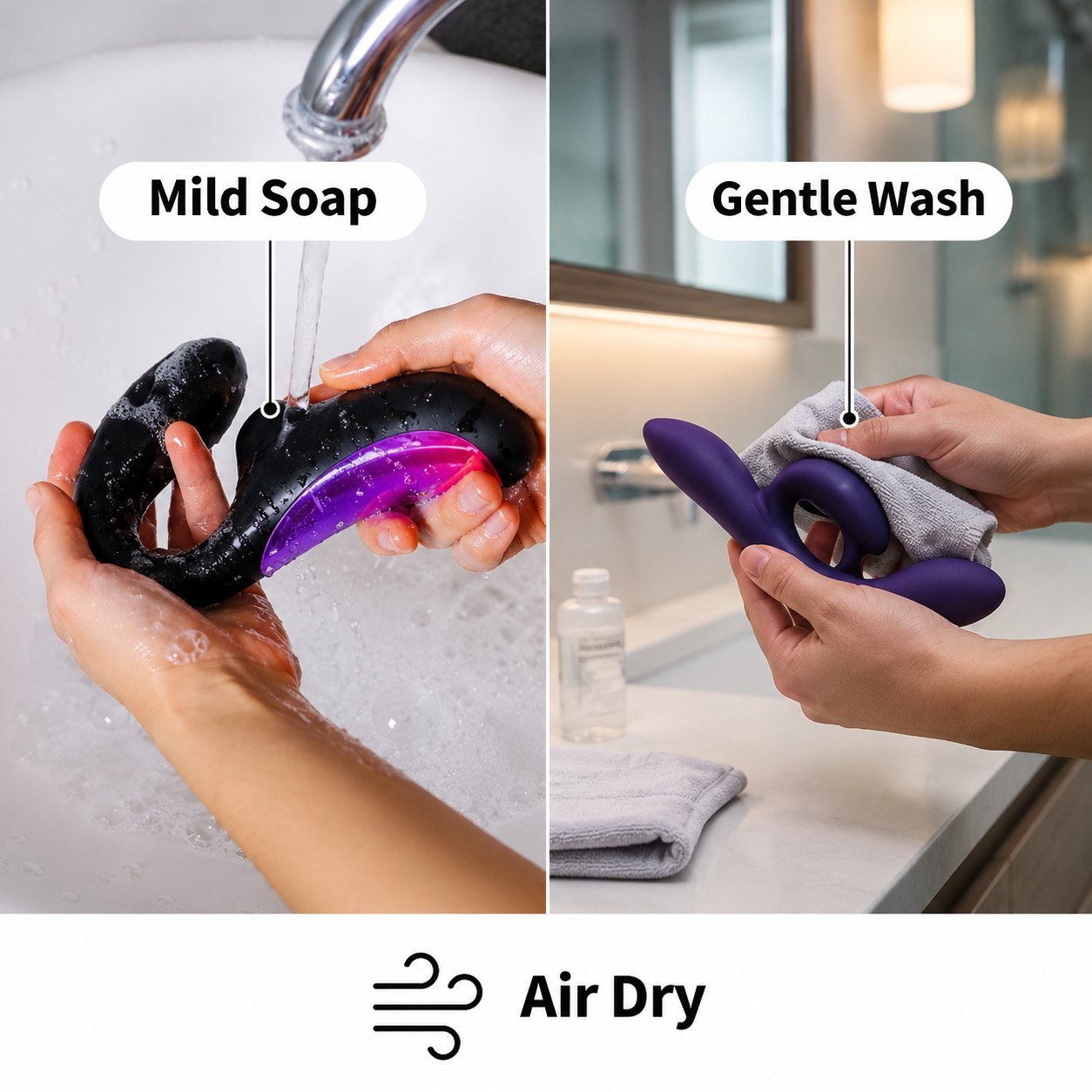
Wash. Warm water with a mild soap or a dedicated cleaner, working around every seam, button recess and molding line.
Rinse. Until you feel no slipperiness left, not just until the lather is gone.
Dry. Pat with a lint-free cloth rather than a towel, which leaves fibers in a texture.
Check. Look for residue at the seams and any change in finish before the product is put away.
Heat is the step to be careful with. WebMD states that a silicone dildo with no vibrating function can be boiled for 5 to 10 minutes, and that glass, steel and silicone can go in a dishwasher as long as they are not battery-operated; for stainless steel it gives a 10% bleach soak rather than boiling. WINYI’s own silicone versus TPE guide is the more careful read: boiling, bleach and dishwasher cycles are not suitable for every silicone product. Treat heat as a per-model question that the model’s own instructions answer, never as something a material name settles for you. If the instructions do not say, soap and warm water is your answer. You can see WINYI’s own silicone vibrators and the material notes published with each one.
Porous: TPE and Soft Blends
TPE and soft blends hold moisture, so the framing above applies: cleaning reduces surface residue rather than removing it. The cleaners for silicone mostly work here too, but the method does not carry over, because the sequence is gentler and slower:
Wash. Warm water with a mild soap, without scrubbing and without a brush.
Rinse. Thoroughly, because residue you leave behind can turn a soft surface tacky.
Dry. Longer than you expect, in open air, until the surface is dry to the touch everywhere.
Store. Only when it is fully dry, and never in a sealed pouch.
For a buyer, that has a commercial consequence worth putting in your product data. WINYI’s material guide notes that silicone and TPE both vary in how they resist liquid, oil and odor, and that performance depends on formulation, structure, finish and processing rather than the material name. So ask for absorption, extractables, oil migration, odor and cleanability evidence on the exact grade and finished part, and treat any “non-porous” or “medical grade” wording as a claim that needs a defined test basis before you repeat it.
Dedicated Cleaner Versus Mild Soap
Here is the rule in one line: mild fragrance-free soap handles non-porous surfaces, and a dedicated toy cleaner earns its place on porous TPE and on coated or motorized products where you want to avoid scrubbing.
WINYI’s own care guidance in its vibrator usage guide tells users to avoid alcohol-, benzene- and acetone-based cleaners, which is the clearest instruction you will get from a manufacturer and the one your insert card should carry. Where a maker explicitly permits alcohol on a specific hard, non-porous model, that instruction governs that model and nothing else. Keep household disinfectant sprays and abrasive pads away from soft and coated products, along with silicone lubricant, which Planned Parenthood notes reacts with solid silicone and damages it.
Table: cleaning agent compatibility. Every cell is conditional on the model’s own instructions, which override this table.
| Cleaning agent | Silicone | TPE | ABS | Stainless steel |
|---|---|---|---|---|
| Dedicated toy cleaner | If permitted | If permitted – preferred | If permitted, wipe on | If permitted |
| Mild fragrance-free soap | Yes – default | Yes | Wipe on only | Yes – default |
| Diluted isopropyl alcohol | No | No | No | If permitted |
| Boiling water | If stated | No | No | If stated |
| Household disinfectant spray | No | No | No | No |
“If permitted” and “if stated” both mean one thing: only where the model’s own instructions say so. No cell in that table is a material property you can quote on its own.
Building a range your customers can look after? Surface finish and the care card in the box are specification decisions. WINYI’s OEM and ODM process lists the QC checkpoints that apply before packing – incoming materials, first-article approval, in-process work, function, charging, battery behavior, waterproof performance where claimed, appearance, packaging and final shipment sampling. See the silicone range.
Motorized Units and Charging Ports
This is where product damage happens, and it is where the answer is firmest: not by immersion.
Start with what a waterproof rating tells you. An IPX number is a test result rather than permission to soak something. Under IEC 60529, the IP code standard, numeral 5 is tested with a 6.3 mm nozzle, numeral 6 with a 12.5 mm nozzle, and numeral 7 covers temporary immersion between 0.15 m and 1 m.
At the WINYI lab, the agreed IPX7 sealing requirement is verified by immersing products at a depth of 1 meter for 30 minutes and then checking for water ingress. That is a result on the models tested rather than proof that every model is waterproof, so ask which models a report covers and what rating each one carries. WebMD notes that most vibrators can be lightly immersed but tells readers to read the instructions first – which is the same per-model question, answered by the model.
So your order of operations on anything motorized is fixed:
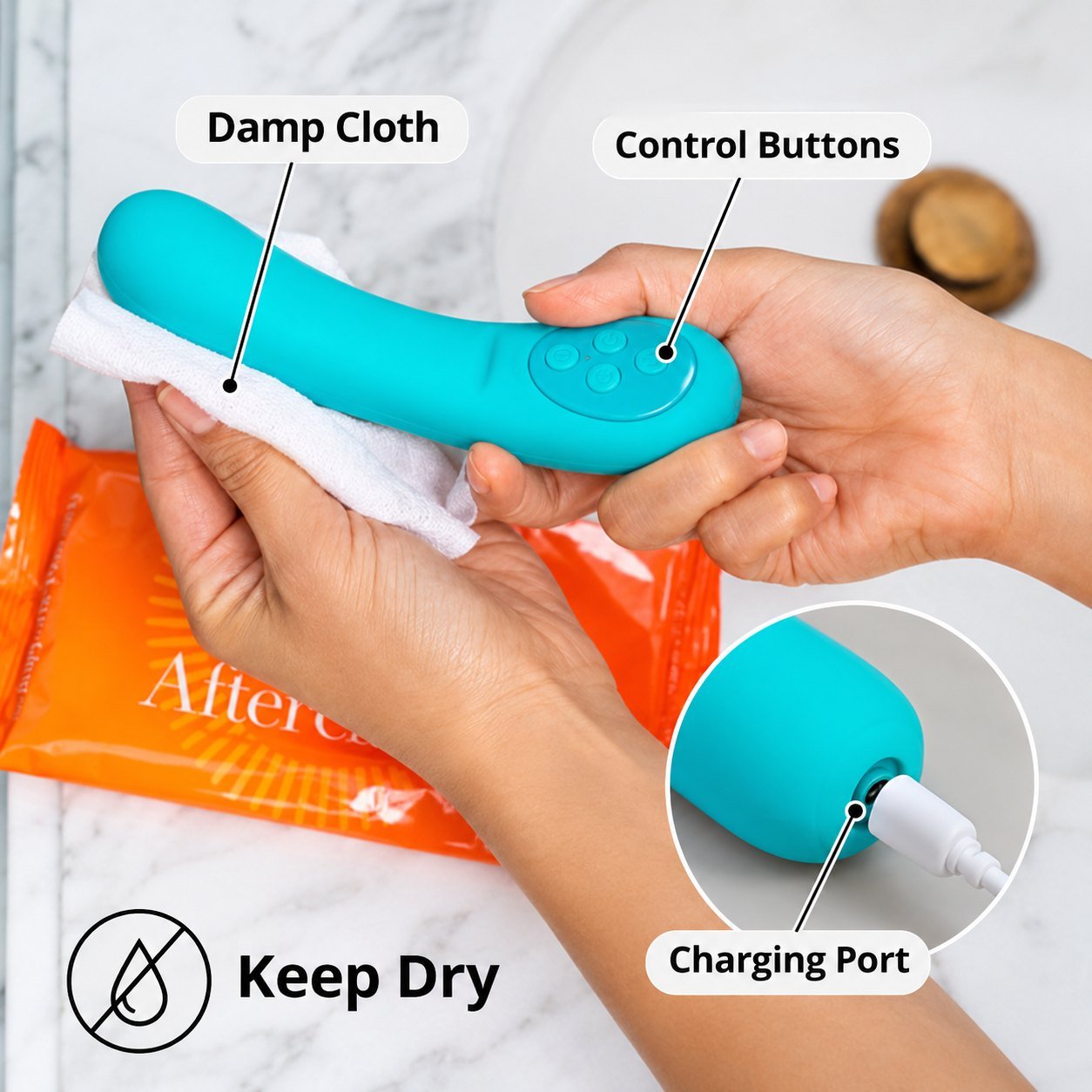
Power off, and unplug the cable if it is charging.
Wipe the body with a damp cloth rather than running it under a tap, unless the rating and the maker’s instructions both tell you otherwise.
Keep water off the ports, the button membranes and any grille.
Dry the contacts fully before you charge.
Three details belong on your care card. A button membrane is a seal, so you wipe it rather than press on it with a wet cloth. A seam around a motor housing is the weakest line on the product, so treat it as a boundary rather than somewhere to scrub. And a charging port should be dry before anything is connected, because moisture there is the most common cause of a premature failure.
Drying and Storage
Drying is the step your customers skip, and a damp product in a closed pouch is the worst case for every material here. It is how a soft surface turns tacky, how a seam develops a smell, and how a coated finish lifts.
Match your drying to the material. A non-porous product needs a pat-down with a lint-free cloth and then open air until no part of it feels damp. A porous product needs noticeably longer. A motorized product needs its ports dry, and the model’s instructions tell you whether any of it can go near a tap.
Keep silicone pieces apart rather than pressed together, keep everything dust-free, cool and out of direct sunlight, and keep soft materials away from oils. A divided case or individual pouches do the job, as long as nothing you put in is wet.
How to Clean Adult Toys: Frequency Reference
Your baseline never changes: clean after every use, and clean before a product touches another person.
WebMD’s guidance says to wash after each use and between uses on different parts of the body, and Planned Parenthood adds that a condom on a shared toy helps keep it clean, changed before it touches anyone else.
Table: cleaning frequency and method by material. Frequency is the same on every row – after each use, and again before a new person uses it – so it is stated here once instead of six times. Deep-clean cells give the condition that makes the method safe rather than an absolute claim.
| Material | Routine clean | Deep clean | Never use | Replace when |
|---|---|---|---|---|
| Body-safe silicone | Mild soap, warm water, rinse, pat dry | Only the method the instructions state | Alcohol, acetone, abrasives, disinfectant spray | Cracked, split or tacky |
| TPE | Mild soap, warm water, no scrubbing, long dry | None – heat and chemicals are unsuitable | Alcohol, heat, bleach, dishwasher | Tackiness that returns after washing |
| ABS or hard plastic | Damp cloth, dry at once | None – wipe only | Immersion, alcohol, abrasives | Crazing, or a loose seam |
| Stainless steel or aluminum | Soap and water, dry fully | Only on a solid piece with no motor, if stated | Abrasives on a polished finish | Pitting, or a damaged coating |
| Borosilicate glass | Soap and water, dry fully | Only on a solid, undamaged piece, if stated | Thermal shock, abrasives | Any chip, crack or scratch |
| Motorized silicone, sealed motor | Wipe, or rinse within its stated rating | None – never immerse beyond the rating | Immersion past the rating, alcohol | Charging fault, or a split seam |
Replacement follows surface condition rather than age, so give your customers that line. A product with a split, a crack, a returning tackiness or a damaged coating has reached the end of its life whatever the date on the invoice, which serves your care card better than a number of months.
Sourcing Adult Toys for Your Brand?
WINYI is an adult-toy OEM and ODM manufacturer in Shenzhen, producing silicone, TPE and ABS products with sealed motor housings and documented material specifications. We support private-label branding, custom packaging and discreet retail presentation, and supply the surface-finish and material declarations your care instructions have to rest on.
Send the detail and you get something you can quote from: your target market and channel, the models you match, material and finish, motor and waterproof requirements, order quantity, packaging, and the launch window. Back comes a model match, a specification sheet with the cleaning and ingress data, a sample plan and a quotation. WINYI states a self-owned 5,000 m² facility, 15,000+ units of daily output and 100+ design patents on its about us page.
Ask for the two kinds of paperwork separately, because ISO 9001 and BSCI describe the factory’s management systems, while ingress test reports and material declarations describe one model. Per model, ask for the document, the issuing body or lab, the test scope, the standard and version, and its validity. Buyers who ask about biocompatibility usually mean ISO 10993-1, Biological evaluation of medical devices, which is written for medical devices rather than adult products, so treat that as a buyer preference rather than a property of the toy.
Request a specification sheet through the wholesale and OEM inquiry form. MOQ, sample terms and lead time are quoted per project, so treat any figure as conditional, and clear the intended brand name in each market you sell in.
Planning a cleaning and care program for your own line? Send the model list and target market, and we will match the material, finish and ingress rating that your care card has to describe.
Request a quotation – OEM and ODM capabilities
Silicone, TPE and ABS · sealed motor housings · IPX-rated options · private label and custom packaging · documented material declarations.
FAQ
How often should adult toys be cleaned?
After every use, without exception, and again before a product touches another person. Any deeper clean sits on top of that, and only where the model’s instructions allow the method. Anything taken out of long storage gets a wash first, because dust settles on a surface like anything else.
Can you boil silicone toys?
Only where the model’s own instructions state it, and only on a piece with no motor, battery or glued insert. WebMD confirms that a silicone dildo with no vibrating function can be boiled for 5 to 10 minutes, while WINYI’s material guide warns that boiling suits only some silicone products. If the instructions do not say, use soap and warm water.
Is soap enough, or do you need a dedicated cleaner?
Mild fragrance-free soap handles non-porous surfaces well, so you rarely need more for silicone, glass or steel. A dedicated toy cleaner earns its place on porous TPE and on coated or motorized products, where you want to lift residue without scrubbing a surface that cannot take it.
How do you clean a motorized toy safely?
Power off first, then wipe the body with a damp cloth. Do not submerge it unless both the waterproof rating and the maker’s instructions allow immersion, and keep water off the ports, the button membranes and any grille. Dry the charging contacts fully before you connect anything.
Can you use alcohol or household disinfectant?
WINYI’s own care guidance tells users to avoid alcohol-, benzene- and acetone-based cleaners, so treat that as your default answer. Diluted alcohol is only for a hard, non-porous model whose own instructions permit it. Household sprays and abrasives have no place on soft or coated products, and soap and water is the safe answer.
How long should a toy dry before storage?
Until it is dry to the touch everywhere, which takes longer than you expect on porous materials. Give a non-porous product a pat-down with a lint-free cloth and then open air, and check the seams before you put it away. Never seal anything damp in a pouch or a case.