

Pelvic floor muscle training has a well-reviewed clinical evidence base, weighted inserts have a much thinner one of their own, and clinical guidance puts the training under professional supervision rather than on a shelf. So the safest first action is to point customers at a qualified clinician before they start, and to print the model’s own instructions rather than a training plan you wrote.
Where the Pelvic Floor Is and Why It Matters
The pelvic floor sits as a layer of muscle across the base of the pelvis, between the pubic bone and the tailbone, and the group you will see named in product copy is the levator ani. Those muscles support the organs above them and take part in everyday functions such as continence, which is why you are selling into recognized clinical practice rather than a wellness category.
Set the boundary first, and say it in your copy. General product information is not a personal training program, and nothing you publish should read like one. Anyone with pelvic pain, pressure, leakage, a prolapse concern, a pregnancy or postpartum question, or any diagnosed condition should speak to a clinician before using an insertable trainer. A product page can tell a customer what a set is. It cannot assess anybody.
How Training Works and Why Supervision Matters
The principle you are selling is simple to describe. You contract the pelvic floor muscles, hold briefly, then release fully. A Kegel needs no equipment at all, which is worth saying plainly on your product page rather than hiding.
A weighted insert changes one thing: the contraction gets a physical cue instead of being invisible.
NICE guideline NG210 encourages women of all ages to do pelvic floor muscle training, and says those programs “should be supervised by a physiotherapist or other healthcare professional with the appropriate expertise”. Supervision includes assessing whether the person can perform a contraction and a relaxation at all, then tailoring the program to that ability. For stress or mixed urinary incontinence it offers at least three months of supervised training.
More contractions are not the answer for everyone, and that is the correction worth making loudest in your copy. Nebraska Medicine’s guide to hypertonic pelvic floor, quoting pelvic health physical therapist Sam Weber, DPT, PT, says performing too many Kegels, or performing them incorrectly, “may increase muscle tension and pain, or worsen your symptoms”, and that Kegels “should never cause pain”. Where muscles are already tight and cannot relax, that source puts restoring flexibility and reducing pain first, through breathing, manual therapy and stretching rather than more strengthening. If a customer describes pain or difficulty relaxing, the route is assessment rather than a heavier ball.
On timing, publish nothing. There is no established timeline for a consumer product, and the figures above describe supervised programs for diagnosed conditions, so a week count on your packaging would have nothing behind it.
Weight Progression: What a Graded Set Actually Is
A pelvic floor trainer range is a weight ladder, and that ladder is a product structure rather than a clinical protocol. Read it as a shape for an instruction card, and let the model’s own instructions override every line you see.
How a graded set is structured. This is a format for a model’s instruction card, not a validated training protocol.
| Stage | Session Length | Move Up When |
|---|---|---|
| Starting | As the model’s instructions state | The lightest weight stays comfortable throughout |
| Settling | Unchanged from the stated length | Nothing aches during or after |
| Stepping up | Unchanged, only the weight changes | The previous stage felt unremarkable |
| Holding | Unchanged, at a comfortable weight | Stop climbing, heavier is not better |
No source sets a session length in minutes, which is why that column points you at the product rather than a number. Your rule for stepping back down is the firmer half: if a weight feels like effort, if anything aches, or if a session leaves discomfort behind, go back a step or stop. Discomfort is a stop signal, and you should name it as one.
WINYI’s kegel ball range follows that structure: the factory defines a graduated kit as two to four balls of increasing weight with a silicone retrieval cord.
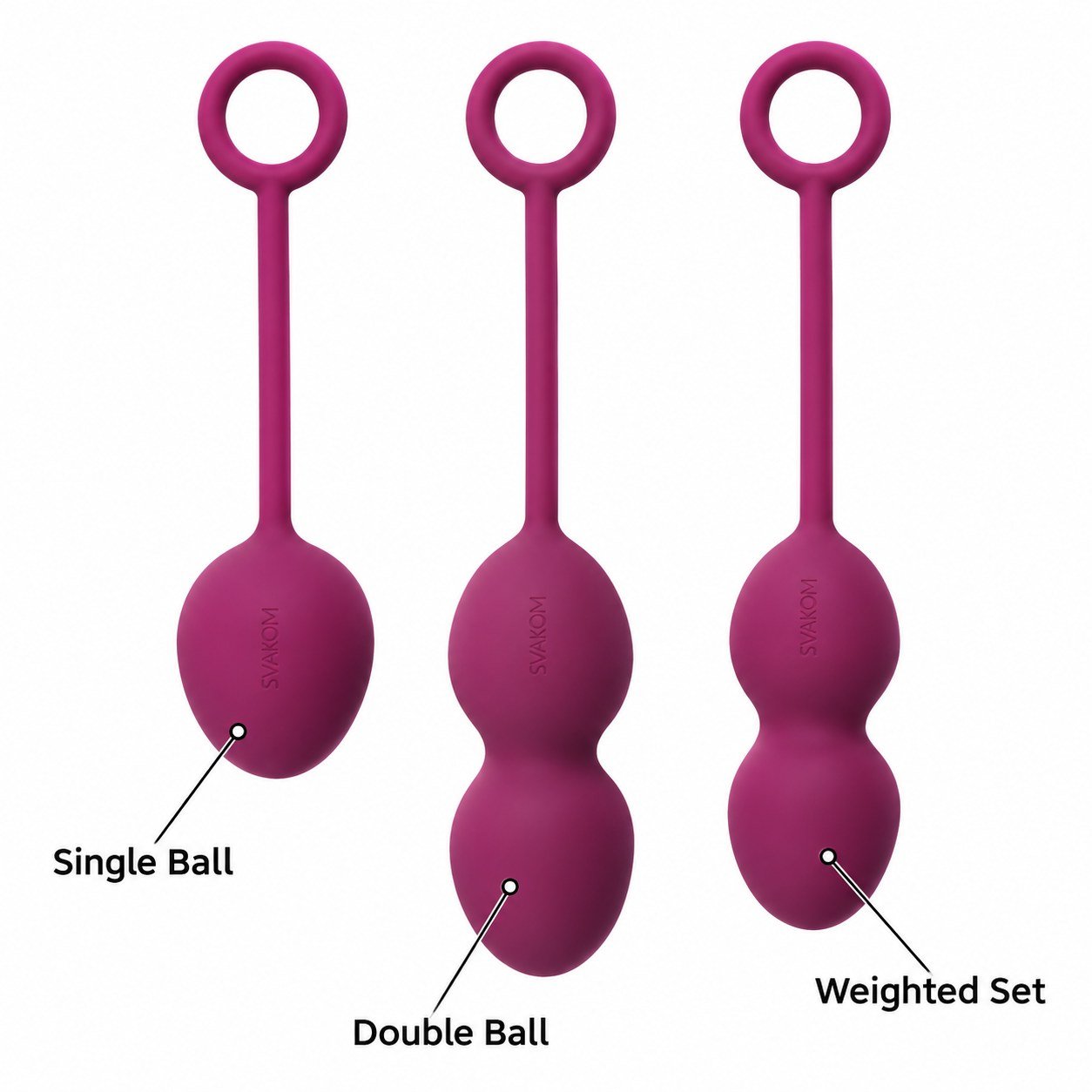
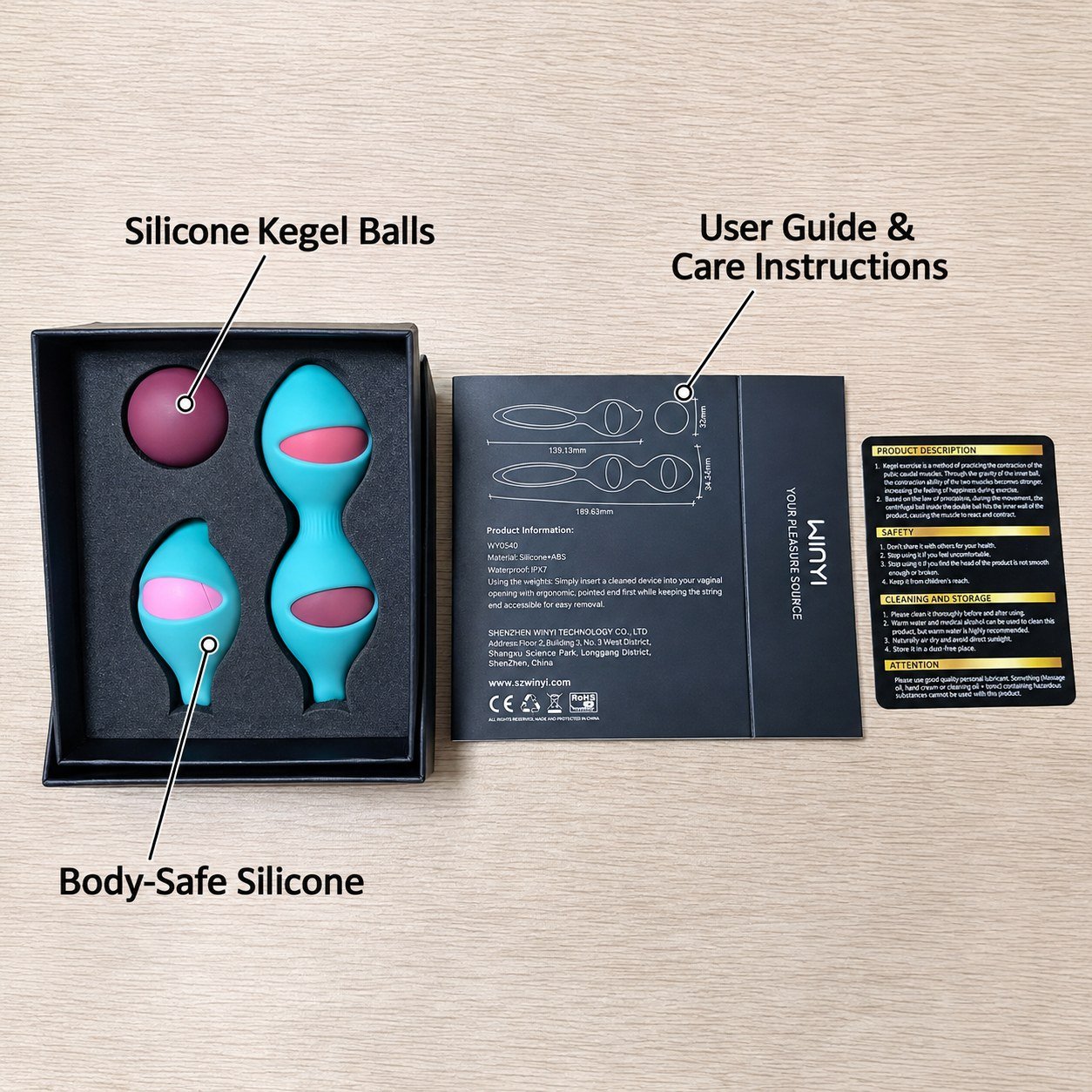
The ladder only means anything if the grams are real. WINYI publishes them per model: the WY0540 set lists single balls at 25, 40 and 65 g and double balls at 90, 105 and 130 g, all at plus or minus 3 g, and the WY0571 set lists 65 g, 91 g and 95 g. Those are the numbers that let a customer, or their clinician, choose a weight and repeat it.
How to Choose a Set
Three criteria decide a set for you, and price is not one.
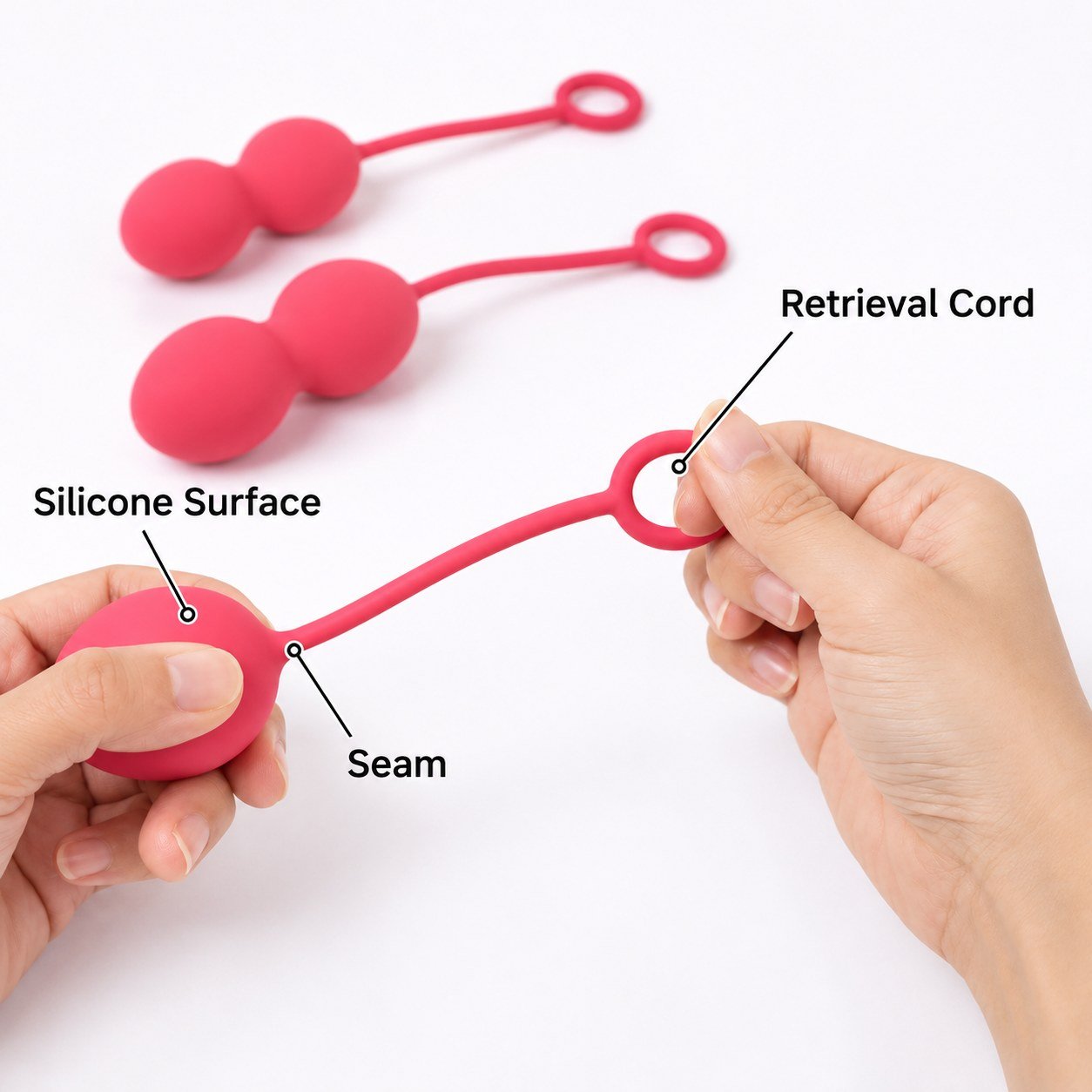
Material, stated per model. The shell touches the body, so it carries the hygiene load for you. Body-safe silicone is the norm, but treat “non-porous” and “medical grade” as claims needing a basis rather than descriptions, because WINYI’s silicone versus TPE guide says those terms need a defined test basis and that cleanability depends on grade, cure, construction and finish. Ask for the composition, coating, seam construction, cord material and compatible cleaners per model.
Published weights, with tolerance. You want small steps, the grams printed, and a tolerance stated next to them. Custom grams help you build a range, and WINYI’s category FAQ confirms it sets weight to your training program rather than to a fixed catalog number, but a stocked model still has to publish an exact figure per ball. Without it a customer cannot choose, repeat or step down.
Hygiene design. Check the seam, the cord and the retrieval end first. A cord you cannot clean, or a joint that traps moisture, becomes a return.
Kegel ball set formats and what each gives you.
| Set Type | Weight Range | Best For | Notes |
|---|---|---|---|
| Single weighted ball | One step, grams per model | A single price point | No ladder, no stages |
| Graduated multi-weight set | A ladder, grams per model | Ranges sold on stages | WINYI: two to four balls |
| Combo set with a strap or cord | Mixed, by component | Gift and collection ranges | Check every part cleans separately |
| Ben wa balls, the traditional pair | Paired form, grams per model | Entry price points | Inner shifting weight, no vibration |
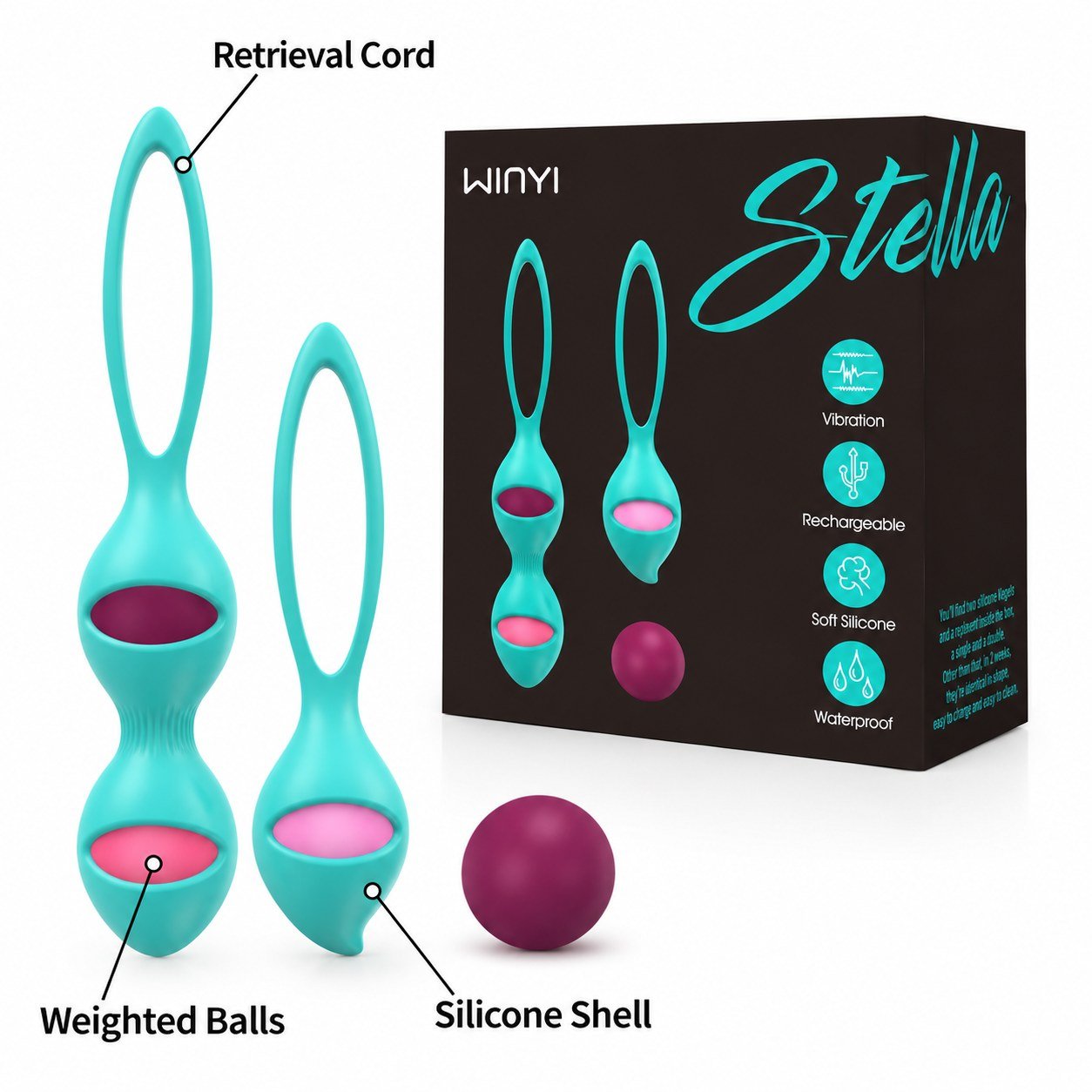
WINYI’s range covers both ends: WY0540 STELLA as a static set with six published weights, WY0425 GRACE as a postpartum-oriented static kit, WY0571 HEIDI as a three-weight set with 10 vibration modes, WY0525 CASSIE as a ten-mode liquid-silicone ball, and WY0569 VICTORIA as an electromagnetic trainer in ABS and silicone with a remote.
Hygiene and Safety
Tell your customer to clean the set before first use, then before and after each session. Warm water with mild soap or a toy cleaner is the routine, and Planned Parenthood’s guidance adds washing before the product touches another person. The care directions supplied with the model govern, not a rule you apply across a shelf.
Dry everything fully before you put it away, store the set in a clean dry case, and dry any cord separately. Then three lines belong on your packaging.
Never share a set without cleaning it.
Never wear them longer than the model’s instructions allow, and never overnight.
Remove them at the first sign of discomfort.
Handle the waterproof claim per model, not per range, whatever your supplier quotes. WINYI’s category page describes shells sealed to IPX6 or IPX7, and the models actually differ: WY0540 and WY0425 are IPX7, WY0571 is IPX6, WY0525 is IPX8 and WY0569 is IPX7. The company’s lab immerses products at a depth of 1 meter for 30 minutes before checking for ingress, which is its own result, so ask which rating and report apply to your model. An ingress rating is a test condition on a new unit, so it tells you nothing about chemical resistance or lifetime.
Keep this in every version of your copy: for pain, numbness, bleeding, a pre-existing condition or any clinical concern, speak to a healthcare professional. This page is general information rather than medical advice, and nothing here diagnoses or treats anything.
What the Existing Research Actually Says
Read this before you approve a claim. The first body of evidence is pelvic floor muscle training itself, the exercise with no device, reviewed extensively. The second is weighted devices, where you have much thinner evidence. They are not interchangeable, and quoting the first to sell the second is the overreach you will see most.
The two systematic reviews that matter. Population and limitations are stated, because none of this transfers to unsupervised consumer use.
| Source | Population | What It Found | Limitation |
|---|---|---|---|
| Dumoulin, Cacciari and Hay-Smith, Cochrane 2018 (CD005654) | Women with urinary incontinence: 31 trials, 1,817 women, 14 countries, against no treatment, placebo, sham or inactive control | Authors state they “can be confident that PFMT can cure or improve symptoms” of stress urinary incontinence and all other types. Participant-perceived cure in stress incontinence rated high quality | The trials delivered training, not a retail product |
| Herbison and Dean, Cochrane 2013 (CD002114) | Women with stress urinary incontinence: 23 trials, 1,806 women, 717 of them using cones, against no active treatment, muscle training or electrostimulation | “Some evidence” that cones beat no active treatment, and that they “may be of similar effectiveness” to muscle training, called “tentative” by the authors | Small trials, quality often hard to judge, high drop-out, and the authors condition it on women finding cones acceptable |
Clinical guidance places the device more narrowly than your market does. NICE NG210 mentions vaginal cones in one context only: for women who cannot perform an effective contraction, it says to consider supplementing supervised muscle training with biofeedback, electrical stimulation or vaginal cones. The guideline treats a weighted device as a supplement inside a supervised program, not a general-purpose product.
That leaves you a narrow, durable position. The exercise has a well-reviewed evidence base from supervised programs for diagnosed conditions, and a weighted set is an aid with thinner evidence of its own. Your copy has to live inside that. Product classification and health-related marketing claims depend on the destination market, so have those reviewed before you launch.
Sourcing a Pelvic Floor Range With Copy That Stays Compliant?
Tell WINYI what you are building and you get back something you can quote. Send your target market and channel, the category and any model numbers you are matching, the material and dimensions, the weight ladder and whether you want it published, control type, target order quantity, packaging and branding needs, the documents your market requires, and the launch window. Back comes a model match, a specification sheet, that market’s document list, a sample plan and a quotation.
WINYI has manufactured adult products in Shenzhen since 2014 and states a self-owned 5,000 square meter facility, 15,000+ units of daily output and 100+ design patents on its about us page. On kegel products you can specify diameter, gram steps, shell texture, hardness, Pantone match, cord material and length, drive type and control, and a private mold gives the shell, weight core and cord collar their own steel tooling.
Separate the two kinds of paperwork when you ask. ISO 9001 and BSCI describe the factory’s management systems rather than your product, while product testing, material declarations and regulatory documents describe one model in one market. WINYI’s certification and compliance page shows what exists, and per model you should ask for the document, the issuing body or lab, the test scope, the standard and version, and the validity. Prototype data is handled under NDA, and mold ownership and exclusivity are agreed in writing.
On commercials, the category page states no minimum on stocked models, logo work from 100 pieces, seven business days for stock counted from payment, and 30 to 35 days for a custom run after sample sign-off, with a six-month warranty. Treat it as conditional until confirmed, and clear the intended brand name in each market you sell in.
WINYI is an adult toy OEM and ODM manufacturer in Shenzhen, producing static kegel sets, graduated pelvic floor trainers, vibrating kegel balls and electromagnetic trainers in body-safe silicone and ABS. We support private-label branding, custom packaging, published gram ladders with tolerance, and the material and test declarations your compliance file needs.
Request a Specification Sheet and Quotation – See Our OEM and ODM Manufacturing Capabilities
Model matching and gram ladders in house – per-model test documents – MOQ, samples and lead time quoted per project
FAQ
How do you use kegel balls?
Follow the instructions supplied with that exact model, because weight, shape and material differ. The ball goes in clean, is used for a short session, then comes out and gets cleaned. Stop at once if anything hurts, and ask a clinician if you are unsure.
How long until kegel balls work?
There is no established timeline, and no published figure supports one for a consumer product. The clinical evidence comes from supervised programs for diagnosed conditions, where NICE describes at least three months for stress or mixed urinary incontinence. Nothing here is guaranteed, so ask a clinician about your situation.
What weight should a beginner start with?
The lightest weight in the set, and only if the model’s instructions say it suits a beginner. Move up only when that weight stays comfortable for a whole session and nothing aches afterward. Heavier is not faster, whatever you read elsewhere. If a weight feels like effort, drop back or stop.
Are kegel balls safe to wear all day?
No. Keep sessions within what the model’s instructions allow, follow the cleaning routine each time, and never wear a set overnight. Remove the balls as soon as you notice any discomfort rather than waiting. Anything persistent means you speak to a healthcare professional.
Do kegel balls replace pelvic floor exercises?
No. The exercise carries the well-reviewed evidence base, and NICE describes it as a supervised program. A weighted set is an aid that gives the contraction a physical cue, and NICE mentions cones only as a supplement for people who cannot contract effectively.
Should you talk to a doctor first?
Yes if you have pain, bleeding, leakage, a pre-existing condition or any clinical concern, and yes if you are pregnant or recently postpartum. Pain during pelvic floor exercises is itself a reason to stop and get assessed, because more strengthening is wrong for muscles that cannot relax.
How do you clean kegel balls?
Wash them with warm water and a mild soap or a dedicated toy cleaner before and after every use, and before the set touches another person. Dry everything fully, including any cord, then store it in a clean, dry case. Your model’s care directions take priority.